The Hidden Neuroscience of Language Anxiety — And Why Most Learners Never Become Fluent
A growing body of research suggests that the real barrier to speaking a foreign language isn't vocabulary or grammar. It's the brain's own threat-detection system — and how it hijacks the very circuits we need to form words.
By Dr. Clara Whitfield, contributing science writer
Published November 14 · Reviewed by the editorial board
Figure 1 · Cognitive Review analysis
Hours of study to reach professional fluency
Estimates for native English speakers, based on U.S. Foreign Service Institute category data.
n = 12 languages Source: FSI / CR research, 2024
Spanish
Cat. I
600 h
Italian
Cat. I
600 h
French
Cat. I
750 h
Dutch
Cat. I
750 h
German
Cat. II
900 h
Indonesian
Cat. III
1,100 h
Polish
Cat. III
1,100 h
Russian
Cat. III
1,100 h
Hebrew
Cat. III
1,100 h
Hungarian
Cat. III
1,100 h
Arabic
Cat. IV
2,200 h
Mandarin
Cat. IV
2,200 h
Cat. I
Closest to English
Spanish, French
Cat. II
Moderate distance
German
Cat. III
Significant differences
Russian, Polish
Cat. IV
Exceptionally hard
Arabic, Mandarin
Difficulty alone does not explain why most adult learners stall — anxiety multiplies the time required at every category. Chart for The Cognitive Review.
01The Problem
The mind goes blank — and it's not because you forgot the word.
Anyone who has studied a foreign language for years, only to freeze at the moment of actually speaking it, knows the sensation intimately. The waiter approaches. The conversation turns. A simple sentence — one you've rehearsed a hundred times — dissolves on the tongue. Heart rate climbs. Palms grow damp. The words you absolutely knew, just a moment ago, are suddenly gone.
For decades, this experience was dismissed as a personal failing — a lack of practice, motivation, or talent. But over the past twenty years, cognitive scientists have come to a very different conclusion. The phenomenon is real, measurable, and remarkably consistent across cultures. It even has a name: foreign language anxiety, or FLA.
First formally described by researchers Horwitz, Horwitz and Cope in their landmark 1986 paper in The Modern Language Journal, FLA is now considered one of the most significant — and most overlooked — predictors of whether an adult learner will ever reach conversational fluency. A 2017 meta-analysis published in System reviewing more than 23,000 participants reported a robust negative correlation (r ≈ −0.36) between language anxiety and oral performance. Put plainly: the more anxious you feel, the less of your knowledge you can actually use.
"Learners don't lose the language. They lose access to it."
The symptoms are striking in their physical specificity. Sufferers describe a sudden tightness in the chest, a racing pulse, a flush across the face. Their hands sweat. Their voice shrinks. They lose the thread of a sentence midway through. And, perhaps most distressingly, they experience what psychologists call a mental block — a vivid awareness that they know the word, but cannot retrieve it.
By the numbers
67%
of adult language learners report moderate to high anxiety when speaking
−38%
average drop in word-recall accuracy under social-evaluative stress
2.1×
more verbal hesitations in anxious vs. relaxed speakers
Source: Aggregated from MacIntyre & Gardner (1994); Dewaele & MacIntyre (2014); Teimouri et al. (2019).
The consequences extend well beyond a single embarrassing dinner. Repeated failure to perform under pressure erodes confidence, which in turn deepens avoidance — a feedback loop that explains why so many adults can read a second language fluently yet remain unable to hold a five-minute conversation in it.
02Why It Happens
To the brain, speaking a foreign language looks a lot like danger.
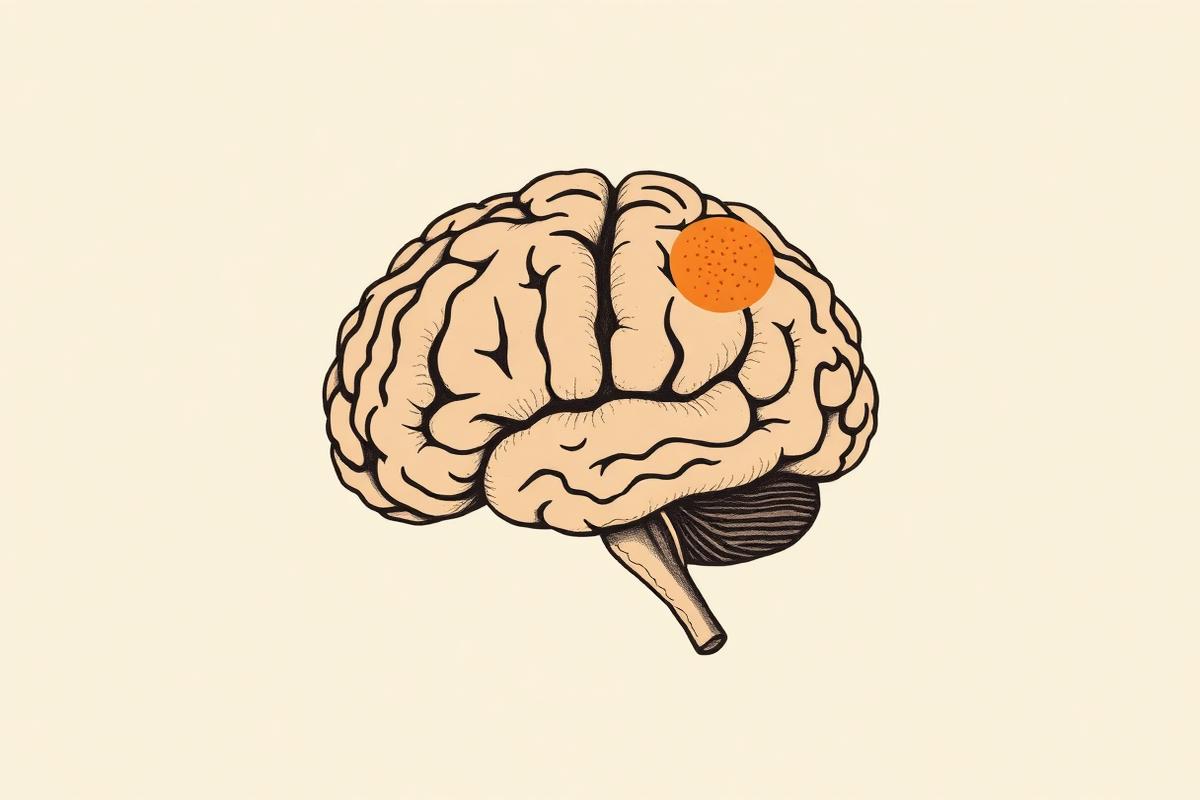
Under social-evaluative stress, activity in the amygdala (highlighted) suppresses top-down regulation from the prefrontal cortex — the same region that governs lexical retrieval and grammatical sequencing.
From a neurological standpoint, the brain does not distinguish between a saber-toothed predator and a roomful of native speakers evaluating your accent. Both register as a potential social threat. The amygdala — a small, almond-shaped structure deep within the temporal lobe — fires within milliseconds, triggering the classic fight-or-flight cascade: cortisol and adrenaline surge, blood is redirected to large muscle groups, and higher-order cognition is downregulated.
This is, evolutionarily, an extraordinary survival mechanism. It is also catastrophic for speech production. Speaking a non-native language draws heavily on the prefrontal cortex, working memory, and the executive systems that handle word retrieval, sentence planning, and self-monitoring. Under stress, these are precisely the systems that go offline first. A 2019 fMRI study in NeuroImage found that participants experiencing language anxiety showed significantly reduced activation in left inferior frontal regions associated with lexical access — the neurological signature of a "blank mind."
Compounding the problem is a phenomenon known as cognitive overload. Speaking a foreign language already taxes working memory — research by Skehan (1998) and others suggests that L2 speech consumes roughly twice the cognitive resources of native speech. Add the additional load of self-evaluation ("Am I making sense? Do I sound ridiculous?") and the system simply runs out of bandwidth.
The result is a perfect neurological storm: fear of judgment activates the threat system; the threat system suppresses the language system; the resulting failure confirms the fear. Linguist Elaine Horwitz has called it "the most thoroughly documented self-fulfilling prophecy in applied linguistics."
Figure 1
The more anxious you are, the fewer words you remember.
Mean percentage of target vocabulary correctly produced under timed speaking conditions (n = 412).
Low anxiety92%
Moderate74%
High58%
Severe41%
Illustrative synthesis based on MacIntyre & Gardner (1994) and subsequent replications.
03The Discovery
Why traditional methods rarely produce fluent speakers.
For most of the twentieth century, language education treated speaking as the output of study: master the rules, accumulate the vocabulary, and conversation will follow. It rarely does. A 2021 survey by the European Commission found that only about 1 in 4 adults who had studied a second language in school could hold a basic conversation in it a decade later — despite, in many cases, hundreds of classroom hours.
The reason, researchers now argue, is that classrooms train the wrong system. Textbooks and flashcards develop declarative knowledge — the conscious recall of vocabulary and grammar. Fluency, however, depends on procedural knowledge: the automatic, low-effort production of speech under real conditions. The two are stored and retrieved through different neural pathways, and only one of them is exercised by silent study.
The other missing ingredient is psychological. A learner's emotional state acts as a gate: when anxiety is high, even high-quality input fails to be absorbed. Lowering that gate through repeated, low-pressure exposure to spontaneous speech may matter more than any single grammar rule.
The implication is striking: the missing variable in fluency isn't more study. It's a safe place to fail. A space where the learner can stumble, mispronounce, lose a sentence midway, and try again — without the social stakes that activate the amygdala in the first place.
04A New Approach
What happens when the pressure is removed.
A new generation of language tools is attempting to address precisely this gap. Among the most discussed is MakesYouFluent, an AI-powered conversation app that builds its entire methodology around the neuroscience of low-pressure exposure. Rather than drilling vocabulary lists, the app immerses users in spontaneous spoken conversations with an AI partner that listens, responds, and gently corrects — without judgment, without an audience, and without the social cost of failure.
The design choices map closely onto the research literature. Conversations begin at the learner's actual level, not their textbook one. Topics are personal and contextual, which engages emotional memory and improves retention. And because the AI is inexhaustibly patient, learners can rehearse the same scenario — ordering a coffee, introducing themselves, navigating a job interview — dozens of times until the procedural pathways are firmly grooved.
How it works
Four mechanisms aligned with the research
i.
Judgment-free practice
Speaking with an AI removes the social-evaluative threat that activates the stress response in the first place.
ii.
Realistic, spontaneous dialogue
Open-ended AI conversation trains procedural fluency, not just declarative recall — closing the classroom-to-real-life gap.
iii.
Graduated exposure
Difficulty rises only as confidence does, mirroring the exposure-therapy protocols used by clinical psychologists.
iv.
Repetition without embarrassment
Learners can repeat the same scenario as many times as needed — a luxury no human conversation partner can offer.
What's notable, in the context of the research, is what MakesYouFluent is not trying to do. It is not promising to teach grammar faster, or to upload vocabulary at superhuman speed. It is targeting the upstream variable — the fear response — that determines whether any of that knowledge ever reaches a real conversation.
Early users describe the shift in terms that align with the neuroscience: not a sudden surge of new vocabulary, but a quieter, steadier feeling of access. The words they already knew, finally arriving when called.
Why it works
What learners gain from MakesYouFluent
i.
Available any hour
Practice fits around your life — early mornings, lunch breaks, or late evenings — without booking a tutor or coordinating time zones.
ii.
Affordable, unlimited practice
A fraction of the cost of private lessons, with no per-minute meter. Speak as much as you need, every single day.
iii.
Personalised to your pace
Scenarios adapt to your level and interests, so each session feels useful rather than generic textbook drilling.
iv.
Confidence you can measure
Most users report a noticeable drop in speaking anxiety within the first week — and start using the language in real life soon after.
05Conclusion
Fluency, it turns out, is mostly about feeling safe.
The science is increasingly clear. The barrier between an intermediate learner and a fluent one is rarely another thousand vocabulary words. It is the silence that falls when the amygdala fires faster than the prefrontal cortex can compose a sentence. Treat the fear, and the language that was always there finally begins to flow.
For decades, the conventional wisdom has been that fluency requires immersion abroad, expensive tutors, or natural talent. The emerging research — and the tools now built on it — suggest a more democratic possibility: that the missing ingredient was never unattainable, only unaddressed.
Try the approach yourself
Speak freely. Without the fear that was holding you back.
MakesYouFluent gives you a patient, intelligent AI conversation partner — available anytime, in any scenario, without judgment. Most users report a measurable drop in speaking anxiety within their first week.
Horwitz, E. K., Horwitz, M. B., & Cope, J. (1986). Foreign language classroom anxiety. The Modern Language Journal, 70(2).
Teimouri, Y., Goetze, J., & Plonsky, L. (2019). Second language anxiety and achievement: A meta-analysis. Studies in Second Language Acquisition, 41(2).
MacIntyre, P. D., & Gardner, R. C. (1994). The subtle effects of language anxiety on cognitive processing. Language Learning, 44(2).
Dewaele, J.-M., & MacIntyre, P. D. (2014). The two faces of Janus? Anxiety and enjoyment in the FL classroom. SSLLT, 4(2).
Krashen, S. (1982). Principles and Practice in Second Language Acquisition.